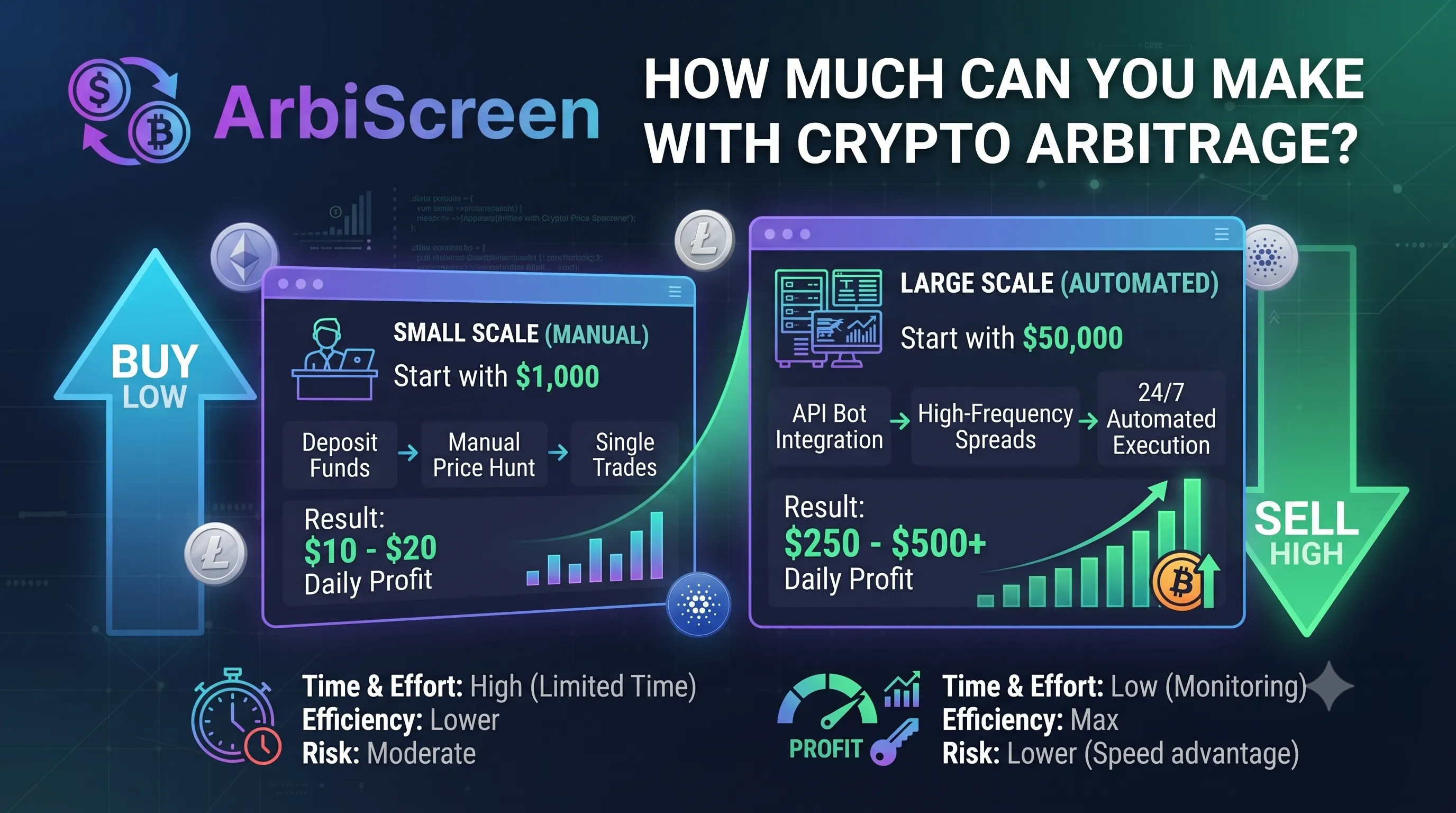
The honest answer: it depends on your capital, your time, and your strategy. Anyone promising a fixed number is selling you something. Crypto arbitrage income scales with how much you put in, how often you trade, and the average net spread you capture after every fee. On this page we walk through the actual math — no hype, no screenshots of Lamborghinis — so you can build a realistic expectation before you deposit a single dollar.
Arbitrage is one of the few crypto activities with a genuinely low-variance profit model: you buy an asset cheaper on one exchange and sell it higher on another, pocketing the difference. It is not free money, but it is far more predictable than directional trading. The numbers below reflect what real users capture with a disciplined process and a scanner that shows net profit, not raw spreads.
Your monthly income is not a single figure — it is the product of five variables. Change any one of them and your results shift dramatically. Understanding this equation is the difference between disappointment and consistent profit.
Below is the core math. Each cell shows the daily profit from deploying your full capital once per listed trade at the given net spread (after fees). Multiply by ~22 active trading days for a monthly figure. These assume you recycle the same capital each trade — a realistic model for stablecoin and spot arbitrage.
⚠️ Reality check: The upper-right cells (marked *) are mathematically true but rarely sustained. At high capital, spreads compress because your own orders move the market, and you cannot find 10 clean 2% opportunities every day. Treat the bottom-right as a theoretical ceiling, not a promise. Most real income lands in the middle band.
Time invested is the variable people underweight. Two people with the same $2,000 can earn wildly different amounts depending on whether they check spreads twice a day or watch the scanner for hours.
On $2,000 capital. You catch 2–3 solid spreads per session, mostly stablecoin and major-pair arbitrage. Set alerts, execute the obvious ones, log off. Low stress, steady side income that comfortably covers a phone bill or groceries.
On the same $2,000. You catch 6–10 spreads, chase geo premiums across time zones, and run funding-rate positions overnight. The extra hours roughly 3–4x the part-time result — because arbitrage rewards presence, not just capital.
The takeaway: doubling your capital doubles income linearly, but going from part-time to full-time can triple it on the same capital. Time is a multiplier, not an add-on. This is why capital-light beginners should max out their hours before rushing to deposit more.
Not all arbitrage pays the same. Each strategy trades off return against effort, capital lock-up, and risk. Here is how the four main approaches compare on a $5,000 account.
Funding-rate arbitrage is the quietest earner — you hold a delta-neutral position and collect payments every 8 hours with almost no active management. P2P and geo-premium pay the most but demand local banking access, KYC, and patience with settlement. Most sustainable traders blend spot as their base and layer funding rate on top for passive yield.
Abstractions only go so far. Here are three composite profiles built from typical user patterns — a student, a side-hustler, and a full-timer.
Capital: $300
Time: 1h/day
Method: Stablecoin arbitrage between USDT/USDC pairs. Low risk, tiny fees, no market exposure. Reinvests everything to compound the balance toward $500, then $1,000.
Capital: $3,000
Time: 3h/day
Method: Multi-exchange spot arbitrage across 5–6 venues with alerts. Executes before/after a day job. Covers rent contribution or a car payment without touching the principal.
Capital: $20,000
Time: 8h/day
Method: Bots for execution speed + manual geo trades. Runs funding-rate positions overnight. This is a genuine job — treated with the discipline of one.
Aggregated anonymously, the top ~5% of active arbitrageurs clear $8,000–25,000/month, and a rare few running six-figure capital with automated infrastructure exceed that. But capital alone does not put you there. What separates top performers is remarkably consistent:
Notice what is not on that list: luck, insider access, or a secret coin. The edge is operational — being faster, holding capital in the right places so you never wait on a deposit, and never chasing a spread that fees will erase. All three are learnable.
Almost nobody profits in week one. Arbitrage income follows a predictable curve, and knowing it prevents quitting during the unavoidable slow start.
More traders fail from these four mistakes than from any lack of opportunity. Every one is avoidable.
Every income-killer above maps to a feature built to defeat it. That is the entire point of ArbiScreen — showing you the number that actually lands in your wallet.
We subtract trading, withdrawal, and network fees so you see real take-home margin — never a misleading raw spread.
Instantly see how fresh a spread is, so you skip stale, illiquid opportunities and act only on live ones.
We surface the cheapest, fastest network to move each coin, keeping gas from eating your margin.
Broad coverage means more simultaneous spreads and more chances to execute daily across major venues.
Dedicated views for Turkey, India, and Africa expose local premium markets where the fattest spreads live.
Fast refresh means you catch spreads while they are still open, not after they have closed.
How does it stack up against other ways to earn with time or capital? Here is an honest side-by-side.
Arbitrage sits in a sweet spot: returns far above staking, risk far below directional trading, and — unlike freelancing — income scales with capital rather than being hard-capped by your hours. The trade-off is that it demands active attention and disciplined execution.
Stop guessing. Open the scanner, filter by net profit, and watch what your capital can actually capture today.
Launch ArbiScreen — Free →Before chasing returns, check whether crypto arbitrage is still profitable after fees, and whether crypto arbitrage is legal where you live.
With active daily trading and disciplined net-spread selection, roughly $200–800/month is realistic on $1,000, depending on how many hours you put in. Part-timers land near the low end; full-timers who run alerts and geo trades reach the high end.
Yes, but it typically requires $15,000–20,000+ in capital, 6+ months of experience, and full-time hours. Our full-timer profile ($20K, 8h/day) earns $2,000–4,000/month. Whether that replaces your salary depends on your location and cost of living.
Almost always fees or execution speed. The calculator assumes net spreads after fees and that you actually catch each opportunity. If you compute gross spreads or arrive late, real profit drops sharply. This is exactly what ArbiScreen's net-profit display prevents.
No. Funding-rate arbitrage is largely passive, and part-time spot trading with alerts can produce $150–400/month on modest capital. But income scales strongly with time invested, so more hours meaningfully increase results.
Most people break even around month 2–3 and reach consistent profit by month 4–6. Month one is usually a small loss as you learn to read net spreads and pre-position capital. Patience through the learning curve is the biggest predictor of success.
Up to a point. Income scales linearly with capital until you get large enough that your own orders compress the spread. Below ~$50K this is rarely a concern; above it, you need more venues and better automation to keep the same percentage return.
Enormously. Reinvesting profits turns steady returns into exponential growth. $2,000 compounding at 5%/month becomes about $3,600 in a year of reinvestment — before adding any fresh deposits. Compounding is the quiet engine behind every top arbitrageur.