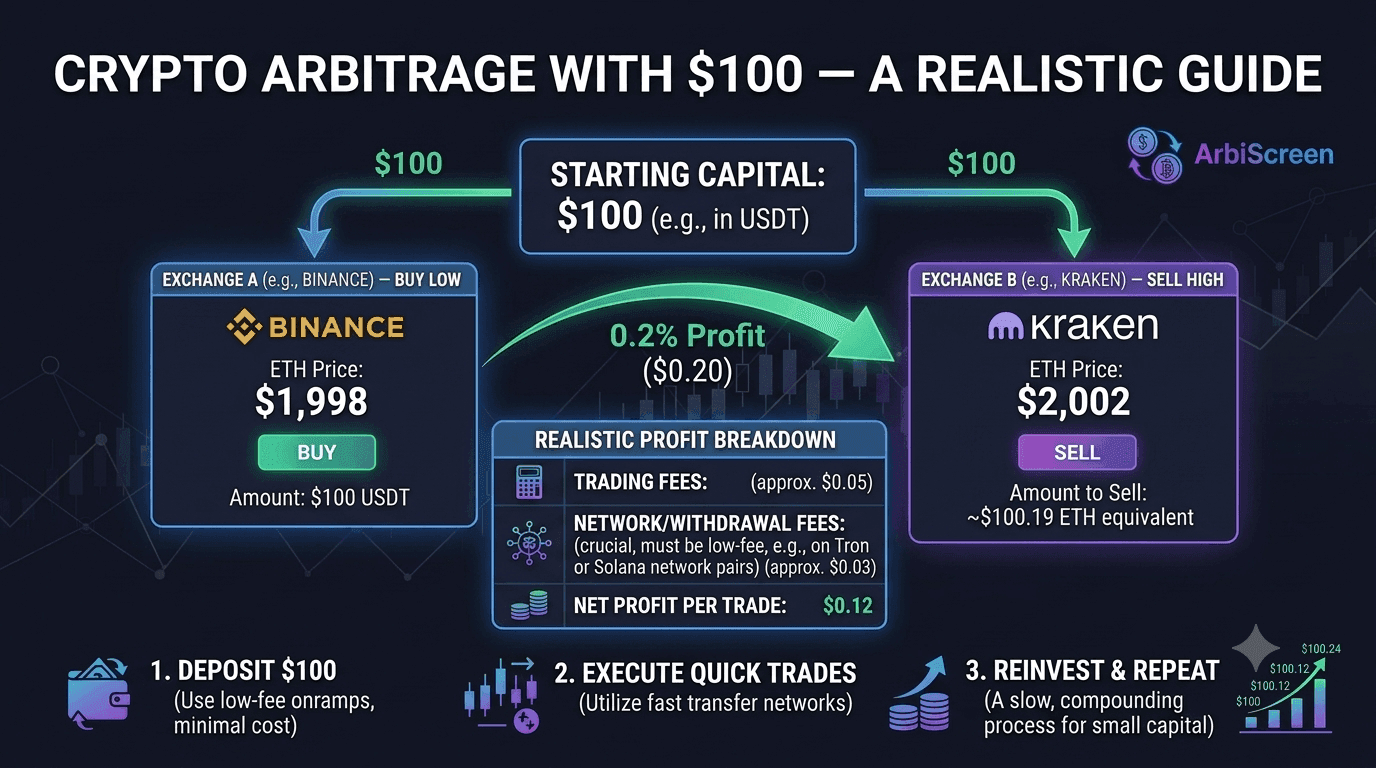
Can you really do crypto arbitrage with just $100? The honest answer is yes — but only if you understand exactly where your money leaks and how to plug those leaks. At $100, every cent of fees matters, and one wrong coin choice can turn a "profit" into a loss.
This guide is for beginners with genuinely small capital. No hype, no "turn $100 into $10,000 overnight" nonsense — just the real math, the real strategy, and the free tools (like ArbiScreen) that make small-capital arbitrage actually workable.
The single biggest mistake beginners make is dumping the whole $100 onto one exchange. Cross-exchange arbitrage — the most reliable kind for small capital — requires you to buy cheap on Exchange A and sell high on Exchange B. If all your money is on one exchange, you can't act the moment a spread appears; you'd have to withdraw first, wait for the transfer, and the opportunity is gone.
So the foundation is simple: split $50 + $50 across two exchanges. This lets you execute both legs of a trade almost instantly. When a coin is cheaper on Exchange A, you buy there and immediately sell the equivalent position on Exchange B — no waiting on blockchain confirmations for that specific trade. You then periodically rebalance (top up whichever side ran low) using a cheap withdrawal network.
Why not $100 on one exchange? Because you'd only be able to do "buy-low, wait, transfer, sell-high" — a slow loop where prices move against you during the transfer. The $50/$50 split turns arbitrage into a fast, repeatable habit instead of a gamble on transfer timing.
At this budget, withdrawal fees decide everything. When you rebalance between exchanges, a flat network fee of $1 on a $50 transfer is a brutal 2% haircut. The trick is to move value using coins with tiny, fixed withdrawal fees. These are your best friends:
| Coin | Network | Typical Withdrawal Fee | Speed |
|---|---|---|---|
| XRP | XRP Ledger | ~0.2 XRP (≈$0.10) | 3–5 sec |
| TRX | Tron (TRC20) | ~1 TRX (≈$0.15) | ~1 min |
| XLM | Stellar | ~0.01 XLM (≈$0.001) | 3–5 sec |
| SOL | Solana | ~0.01 SOL (≈$1.50)* | ~10 sec |
| BTC | Bitcoin | ~0.0002 BTC (≈$12+) | 10–60 min |
| ETH | Ethereum (ERC20) | ~0.001 ETH (≈$3–8) | 2–5 min |
*SOL fees vary by exchange; some charge a flat exchange fee well above the base network cost. Always check the live withdrawal fee before moving funds.
The pattern is obvious: XRP, XLM, and TRX let you move $50 for pennies, while BTC and ETH would eat 10–25% of your capital in a single transfer. For $100 traders, low-fee coins aren't a preference — they're the whole game.
Let's walk through a realistic trade. You have $50 on Binance and $50 on KuCoin. ArbiScreen flags a spread on XRP/USDT.
Net result on this trade
Gross spread $0.75 − buy fee $0.05 − sell fee $0.05 − amortized transfer ~$0.10 = ≈ $0.55 net. Chain a few of these and a couple of larger 2–3% spreads, and $1–3 per trade is the realistic range.
Here is why beginners lose money: they try to arbitrage BTC or ETH because those are the coins they know. Watch what happens with a healthy-looking 1% spread on BTC at $100 capital:
| Line item | BTC trade ($100) | XRP trade ($100) |
|---|---|---|
| Gross profit @ 1% spread | +$1.00 | +$1.00 |
| Trading fees (0.1% ×2) | −$0.20 | −$0.20 |
| Withdrawal / network fee | −$12.00 | −$0.10 |
| Net result | −$11.20 LOSS | +$0.70 PROFIT |
Same spread, same capital — one is a disaster, the other is a win. At $100, the withdrawal fee isn't a rounding error; it's the difference between a business and a bonfire. Never arbitrage BTC/ETH at small capital. Save those for when you're moving thousands, where a $12 fee becomes negligible.
You want exchanges with low minimum trade sizes, low taker fees, and cheap withdrawals on the coins above. These four are the workhorses for small accounts:
| Exchange | Min Trade | Maker / Taker | XRP/TRX Withdrawal |
|---|---|---|---|
| Binance | ~$5 | 0.10% / 0.10% | ~$0.10 / ~$0.15 |
| KuCoin | ~$1 | 0.10% / 0.10% | ~$0.10 / ~$0.15 |
| MEXC | ~$1 | 0.00% / 0.05% | ~$0.10 / ~$0.15 |
| Gate.io | ~$3 | 0.09% / 0.09% | ~$0.12 / ~$0.15 |
MEXC's near-zero maker fees make it excellent as your "sell" leg. A common small-capital pairing is MEXC + KuCoin or Binance + KuCoin — both have low minimums and cheap low-fee-coin withdrawals. Fees change; always confirm live rates before committing.
Be realistic. With $100, you're not day-trading 50 times an hour — the spreads that survive fees don't appear that often on the low-fee pairs you're watching. A grounded target is 2–5 quality trades per day, each netting $1–3.
That's a 60–300% monthly return on $100 in percentage terms — which sounds insane precisely because the dollar amounts are small. Don't confuse the percentage with the paycheck. The point of the $100 stage isn't the income; it's learning the mechanics with real money at low risk before you scale.
Compounding is where small capital gets interesting. Reinvest every profit instead of spending it:
Months 1–3 · Conservative
Stick to XRP/XLM/TRX between two exchanges. Aim for consistency, not size. Reinvest profits. Realistic growth: $100 → ~$180–250.
Months 4–6 · Scaling Up
Add a third exchange and a fourth low-fee pair (e.g. SOL when fees allow). Larger position sizes mean the same % spread pays more. Target: ~$250 → $450–600.
Months 7–12 · Multiple Pairs
Run several pairs across 3–4 exchanges, use ArbiScreen alerts to catch spreads while you sleep, and start considering stablecoin arbitrage for lower-risk volume. Target: crossing $1000.
These are illustrative targets, not guarantees. Market conditions, spread availability, and discipline all move the numbers.
ArbiScreen is free, which matters enormously when your whole account is $100 — a $30/month paid scanner would eat half your monthly profit. Here's how to use it for small capital specifically:
Don't add capital just because you're excited. Add it when you see these signals:
If the volatility of XRP or SOL makes you nervous, stablecoin arbitrage is a gentler on-ramp. USDT and USDC occasionally diverge slightly between exchanges (e.g. USDT at $0.9990 on one, $1.0010 on another). The spreads are smaller — usually 0.1–0.4% — but so is the price risk, since you're holding assets pegged to $1.
Move USDT over TRC20 (Tron) for a ~$1 flat fee, or better, keep a float on both exchanges and rebalance rarely. It's lower reward but also lower stress — a good place to build the habit before chasing juicier volatile-coin spreads.
Yes — for learning and small, real profits. Just use low-fee coins and split across two exchanges. Don't expect life-changing income; expect a hands-on education with modest upside.
BTC withdrawal fees (~$12) exceed your entire per-trade profit at $100. You'd lose money on almost every trade. Stick to XRP, XLM, or TRX.
With 2–5 trades a day at $1–3 each, roughly $60–300/month — if you reinvest and stay disciplined. Some months will be quieter than others.
No. ArbiScreen is free, which is ideal at $100 — a paid tool would eat your margins. Start free and only consider paid tools once your capital is much larger.
Binance + KuCoin or MEXC + KuCoin are solid: low minimums, low taker fees, and cheap XRP/TRX withdrawals. Confirm live fees before funding.
Generally yes — you avoid price swings while transferring. The trade-off is smaller spreads. Many beginners start with stablecoins, then graduate to low-fee volatile coins.
After 3–4 weeks of consistent, repeatable profit and zero network mistakes. Let skill, not excitement, decide when to scale.
ArbiScreen shows you fee-adjusted, net-profitable spreads in real time — free, and perfect for $100 traders. See the opportunities before you commit a cent.
Open ArbiScreen Free →