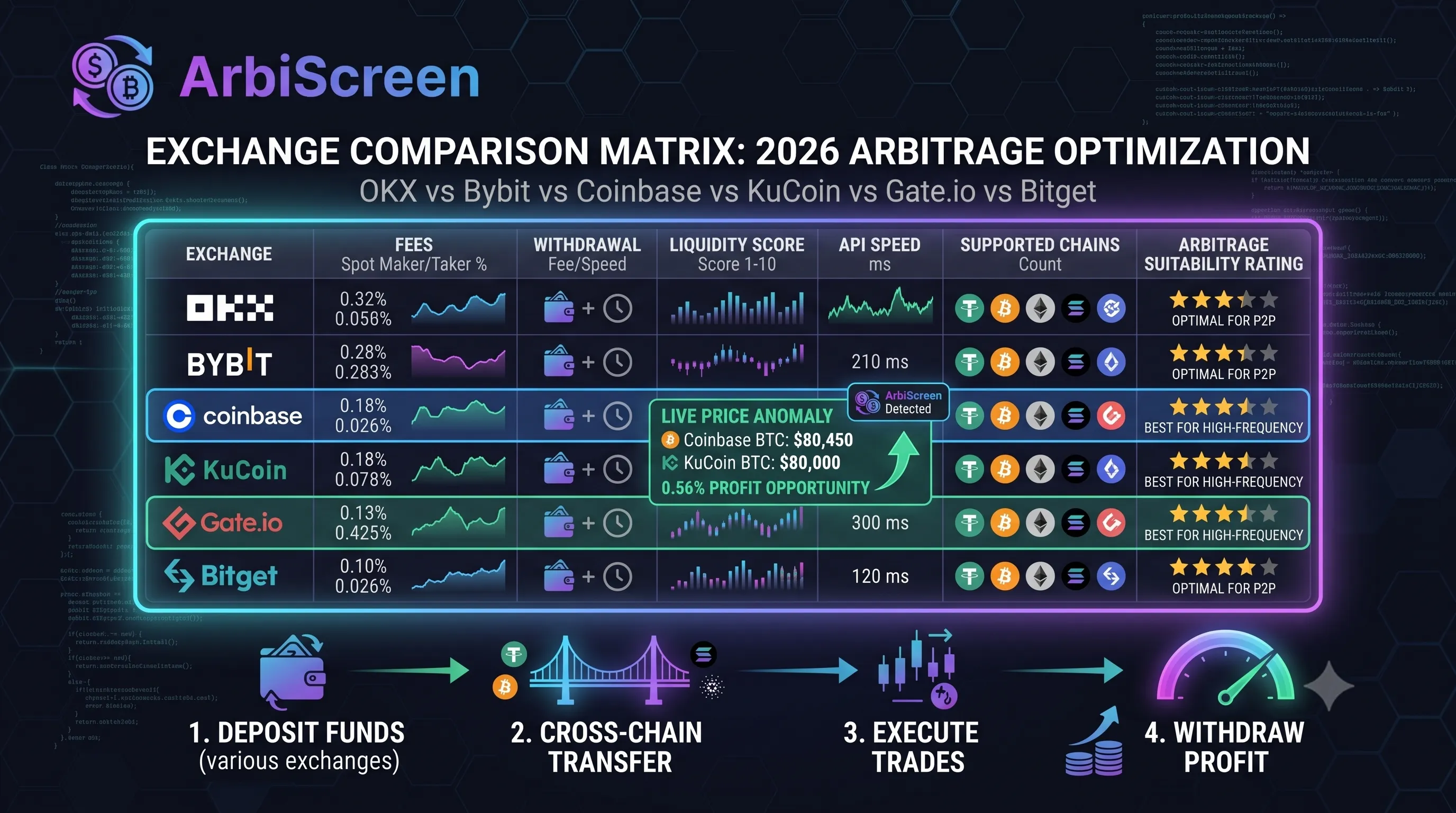
Six of the biggest crypto exchanges, one question: which one actually helps you earn from arbitrage in 2026?
OKX, Bybit, Coinbase, KuCoin, Gate.io and Bitget each move enormous volume — but they behave very differently on the two things arbitrage traders care about most: trading fees and funding rates. This guide compares all six the way a spread-hunter would read them, then shows which exchange fits spot arbitrage, funding-rate arbitrage and triangular arbitrage. All fees below are standard base-tier rates before token or VIP discounts — treat them as a starting map, and always confirm the live schedule on each exchange.
Arbitrage is the practice of buying an asset cheaply on one venue and selling it higher on another. The wider the price gap between exchanges — and the lower your fees — the more you keep. So the "best" exchange for arbitrage is rarely the one with the flashiest app. It is the one where the maker/taker fee is low, the funding rate swings in your favour, and the coin you want is actually listed with real liquidity.
These six sit at the centre of that map. Between them they list most of the tradable universe, run deep perpetual-futures books, and quote prices that constantly drift a few tenths of a percent apart — which is exactly the gap an arbitrage scanner is built to catch.
| Exchange | Spot taker* | Futures taker* | Listed coins** | Best arb fit |
|---|---|---|---|---|
| OKX | ~0.10% | ~0.05% | 350+ | Low-fee spot + CEX-DEX |
| Bybit | ~0.10% | ~0.055% | 600+ | Funding-rate arbitrage |
| Coinbase | ~0.60% (Advanced lower) | ~0.05% | 250+ | US-regulated / fiat legs |
| KuCoin | ~0.10% | ~0.06% | 700+ | Altcoin / new-listing gaps |
| Gate.io | ~0.20% (GT discount) | ~0.05% | 1,700+ | Long-tail / micro-cap spreads |
| Bitget | ~0.10% | ~0.06% | 800+ | Funding + copy-trade flow |
*Standard base-tier maker/taker before VIP or native-token discounts; fees fall meaningfully at higher volume or when you hold the exchange token. **Approximate count of listed assets — figures move constantly. Always confirm live rates before trading.
One of the cheapest major venues on both spot and futures, with tight base-tier fees and deep BTC/ETH liquidity. Per-symbol funding on perpetuals gives clean cash-and-carry setups.
Arbitrage angle: Strong for low-fee spot arbitrage and CEX-DEX plays — its built-in Web3 wallet and DEX aggregator let you compare a centralised price against on-chain liquidity in one ecosystem.
2026 direction: Doubling down on Web3 wallet, DEX aggregation and a unified trading account — positioning as a bridge between CEX and on-chain arbitrage.
Built around perpetual futures with a Unified Trading Account that lets one balance back spot and derivatives at once — ideal for holding a spot long against a short perp.
Arbitrage angle: The go-to for funding-rate (cash-and-carry) arbitrage: buy spot, short the perp, and collect a positive funding rate while staying market-neutral.
2026 direction: Expanding its unified account, spot listings and institutional tooling — the derivatives depth keeps growing, which is exactly what funding-rate traders want.
Simple app fees are high, but Coinbase Advanced Trade cuts maker/taker dramatically. Its real value is regulatory standing and clean USD fiat rails.
Arbitrage angle: Best used as the regulated fiat leg of a cross-exchange trade in the US, or as a reference price. Retail app fees eat spreads — use Advanced Trade, never the basic buy button.
2026 direction: Leaning into US regulatory clarity, institutional custody and derivatives — the compliance-first venue when geography or banking matters more than the lowest fee.
Lists new and mid-cap tokens fast, often before larger venues. Low base spot fees and a large perpetual roster.
Arbitrage angle: Prime hunting ground for new-listing and altcoin gaps — freshly listed coins are mispriced against other exchanges for hours, and KuCoin frequently has them first.
2026 direction: Continuing aggressive listings and Web3/earn products — the venue where long-tail arbitrage opportunities appear earliest.
Lists more assets than almost anyone — well over a thousand — so it is the natural counterparty for obscure tokens. Base fees are a touch higher but drop with the GT token.
Arbitrage angle: Unbeatable for long-tail and micro-cap spreads: thin, illiquid coins drift furthest from their price elsewhere, and Gate.io usually has them listed when rivals do not.
2026 direction: Broadening its already-massive listing catalogue and startup/launchpad pipeline — the widest net for exotic-pair arbitrage.
Known for copy-trading and a fast-growing derivatives book. Competitive base fees and strong perpetual liquidity on majors and popular alts.
Arbitrage angle: Good for funding-rate arbitrage, and its heavy copy-trade flow can push funding rates to attractive extremes you can harvest against a spot hedge.
2026 direction: Scaling derivatives, copy-trading and on-chain products — the retail-derivatives flow is what makes its funding rates worth watching.
Spot (cross-exchange) arbitrage
Lowest fees win. OKX and KuCoin for majors and alts; Gate.io for the long tail. Coinbase only via Advanced Trade or as a fiat exit.
Funding-rate (cash-and-carry) arbitrage
Deep perps and unified balances win. Bybit first, then Bitget and OKX. You hold spot and short the perpetual to pocket funding while staying market-neutral. See our funding-rate explainer.
New-listing & long-tail arbitrage
KuCoin and Gate.io list first and list most — that is where fresh, mispriced tokens appear before the rest of the market catches up.
Watching six exchanges by hand is impossible — prices move every second. ArbiScreen monitors 17 exchanges at once, including all six above, and surfaces live spreads, funding rates and net profit after fees so you see the real opportunity, not a gross number that a fee quietly erases.
Instead of asking "which single exchange is best," ArbiScreen answers the better question: where is the gap between them right now, and is it worth trading after costs? Explore the live arbitrage scanner or compare venues in the exchange hub.