
Every block on Ethereum, BSC, Polygon, Arbitrum, and Solana hides a quiet auction. Before a single pending transaction is confirmed, specialized bots and block producers decide the order in which transactions land — and that order determines who captures value from price gaps, liquidations, and mispriced trades. This is MEV: Maximal Extractable Value, the profit that can be extracted by controlling transaction sequencing rather than by trading better than everyone else. MEV arbitrage sits at the center of this ecosystem. It is the single largest category of MEV extraction by volume, and understanding how it works is essential for anyone running a trading desk, building a bot, or simply trying to protect a swap from being sandwiched. This guide breaks down the mechanics, the supply chain, the economics, and the practical defenses available to traders in 2026.
Maximal Extractable Value refers to the maximum value a block producer (a miner under proof-of-work, a validator under proof-of-stake) can extract from a block beyond the standard block reward and gas fees, by strategically including, excluding, or reordering transactions within that block.
The term originated as "Miner Extractable Value" in early Ethereum research, but was renamed "Maximal Extractable Value" once proof-of-stake validators took over block production and the phenomenon proved to apply well beyond mining. The core insight hasn't changed: whoever controls transaction ordering controls a hidden revenue stream that most users never see.
MEV is not inherently malicious. Some MEV extraction — like arbitrage that aligns prices across decentralized exchanges — improves market efficiency. Other forms, like sandwich attacks, directly extract value from ordinary users engaged in normal trading. The distinction matters when evaluating MEV strategies and when deciding how much MEV protection a given transaction needs.
Key facts about MEV worth internalizing before going further:
To understand MEV arbitrage, you need to understand the lifecycle of a transaction from submission to confirmation.
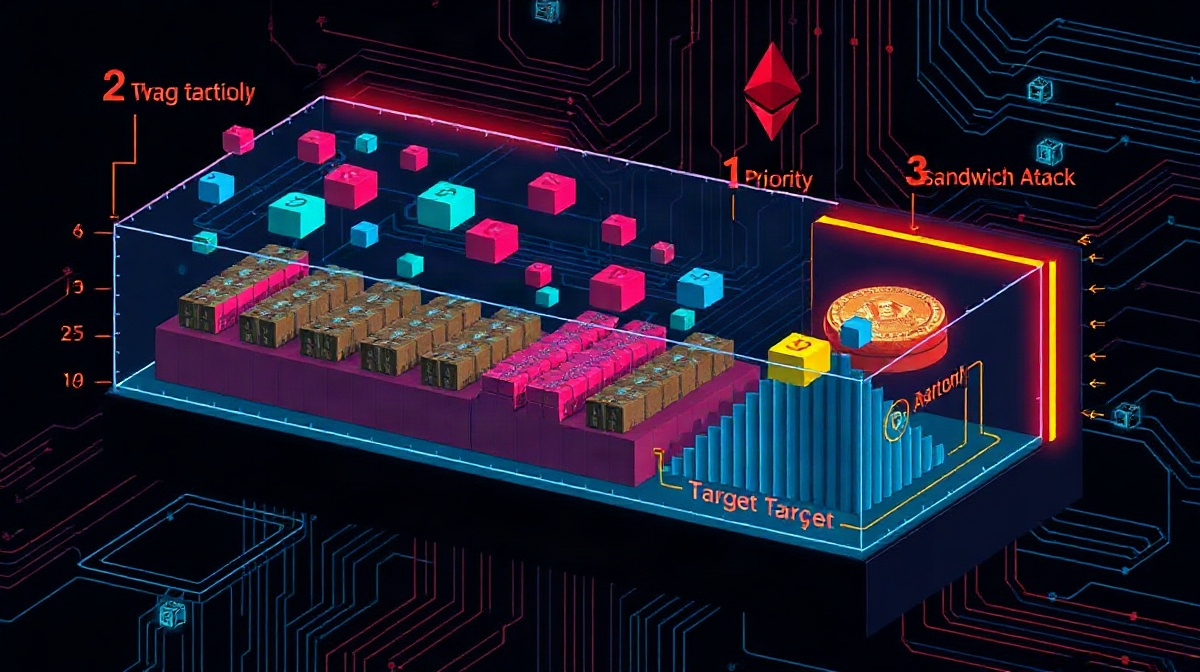
When a user submits a transaction, it doesn't go straight into a block. It first sits in the mempool — a public (or sometimes private) waiting room of pending transactions broadcast across the network. Searchers run specialized nodes that continuously scan this mempool, parsing every pending transaction to detect profitable patterns: a large swap that will move a pool's price, a loan that's about to become undercollateralized, or a price divergence between two venues.
Mempool monitoring is the raw material of MEV. Without visibility into pending transactions before they're confirmed, there is no MEV opportunity to capture — the entire strategy depends on seeing what's coming and reacting before the block closes.
Once a searcher identifies an opportunity, the next step is getting their own transaction included in the same block, in the right position relative to the triggering transaction. This is where transaction ordering becomes a weapon. A searcher might need their arbitrage transaction to land immediately after a large swap (backrunning) or immediately before and after it (a sandwich). Ordering is not guaranteed by submission time — it's determined by whoever assembles the block and the fee or bribe attached to each transaction, and that ordering ultimately determines which bot, if any, captures the opportunity.
Modern block production is no longer a single miner picking transactions by gas price. It's a specialized role performed by block builders, who receive transaction bundles from searchers, simulate different orderings to maximize total value (gas fees plus any bundled payment to the builder), and submit the most profitable full block to a validator through relays like those built on the MEV-Boost software. This builder market is where most competitive MEV extraction now actually happens, rather than on-chain in a simple public gas auction.
MEV strategies fall into several distinct categories, each with different risk profiles, technical requirements, and ethical implications.
Frontrunning means detecting a pending transaction and submitting your own transaction with a higher fee so it executes first, capturing the opportunity before the original transaction does. Classic frontrunning targets things like token launches or oracle updates where being first has clear value.
Backrunning places a transaction immediately after a target transaction in the same block. This is the foundation of MEV arbitrage: after a large swap moves a pool's price, a backrunning bot immediately trades against the new price to capture the resulting arbitrage opportunity before the market re-equilibrates naturally.
A sandwich attack wraps a victim's pending transaction between two attacker transactions — one that pushes the price up before the victim's trade executes, and one that sells back down afterward, pocketing the difference. Sandwich attacks are the most user-hostile MEV strategy because they directly extract value from a specific trade rather than correcting a market inefficiency.
Lending protocols rely on liquidation bots to repay undercollateralized loans and seize discounted collateral. This is a legitimate and necessary MEV strategy — without competitive liquidators, protocols would accumulate bad debt. Liquidation MEV competition is fierce, with bots racing to be first to call the liquidation function the instant a position crosses its threshold.
Arbitrage is the MEV strategy with the broadest economic justification. When a trade on one exchange pushes an asset's price away from its price elsewhere, an arbitrage bot captures the gap by buying low on one venue and selling high on another, which pushes both prices back toward alignment. This is MEV arbitrage, and it's the subject of the rest of this guide.
MEV arbitrage is the process of using transaction-ordering privileges — or simply mempool speed — to capture price discrepancies between decentralized exchanges, often within the same block that creates the discrepancy.
Here's the mechanism in practice: a trader swaps a large amount of ETH for USDC on one DEX. That single transaction shifts the pool's internal price according to its bonding curve. Now that pool is priced slightly differently than every other venue trading the same pair. An arbitrage bot watching the mempool sees the pending swap, simulates its effect on the pool, and submits its own backrunning transaction in the very next slot: buy the now-underpriced asset on the first pool, sell it on a second pool where the price hasn't moved, and pocket the spread.
This differs from traditional crypto arbitrage for beginners in one crucial way: MEV arbitrage doesn't wait for a price gap to simply exist in the market — it reacts to pending transactions that are about to create one, and it captures the gap atomically, often within the same block, using tools like flash loan arbitrage to avoid needing upfront capital at all.
The economics work because DEX prices are mechanically determined by pool reserves, not by a continuous order book. Any trade large enough to move reserves materially creates a brief, predictable, and quantifiable arbitrage opportunity. The bot doesn't need to predict the market — it only needs to calculate the exact trade size that will re-equalize prices across venues and compute whether the resulting profit exceeds the gas and fees required to capture it.
Despite being classified as MEV, arbitrage is broadly value-positive for the ecosystem. It:
Compare this to a sandwich attack, which extracts value from a specific victim with no corresponding efficiency gain. DeFi arbitrage strategies that rely on cross-pool or cross-chain price correction are a net positive; MEV extraction via sandwiching is a net negative for the end user.
MEV today runs through a structured, multi-party pipeline rather than a single actor spotting and executing opportunities end to end.
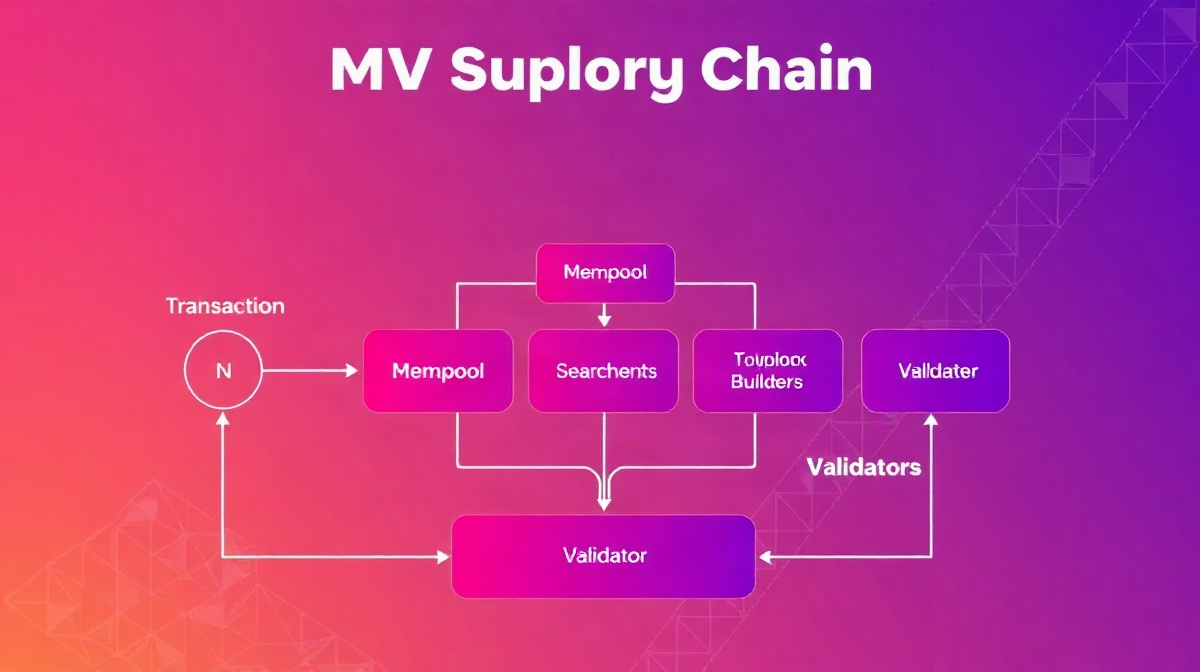
Searchers are the bots and teams that scan the mempool, identify MEV opportunities, and construct transaction bundles designed to capture them. Searchers compete intensely with each other — the same arbitrage opportunity might be spotted by dozens of bots simultaneously, and only the one whose bundle is accepted gets paid.
Builders aggregate bundles from many searchers, along with ordinary pending transactions, and assemble full blocks designed to maximize total extractable value for themselves and the validator. Builders run private simulation infrastructure to test thousands of transaction orderings per block and select the most profitable combination.
Validators (post-Merge Ethereum) or miners (proof-of-work chains) are responsible for proposing the next block. Rather than building blocks themselves, most validators now outsource this to the MEV-Boost middleware, which connects them to multiple competing builders through relays and lets them simply accept the highest-paying block header without seeing its contents in advance.
Flashbots, the organization that pioneered the current MEV supply chain architecture, built the original private relay and auction system specifically to reduce the negative externalities of public mempool competition — namely failed transaction spam and uncontrolled gas wars. Their infrastructure is now a standard part of how the majority of Ethereum blocks are produced.
This supply chain structure explains why MEV competition increasingly happens off-chain, in private auctions between searchers and builders, rather than in the visible, chaotic gas-price wars of early DeFi.
Before the Flashbots relay model matured, MEV competition played out almost entirely through Priority Gas Auctions (PGAs) — searchers bidding up gas fees in real time, transaction by transaction, to win inclusion priority. PGAs were wasteful: losing bots still paid gas for failed transactions, and the bidding war itself congested the network.
Today, competition has shifted toward bundle-based auctions, where searchers submit a single bundle with an explicit bribe to the builder, and only the winning bundle pays anything. This has lowered failed-transaction waste but intensified competition on speed, simulation accuracy, and private infrastructure.
Success rates stay relatively low across the board because the same MEV opportunity is typically visible to every competing searcher at once. The rate of profitable captures depends heavily on how fast a bot can detect, simulate, and submit — milliseconds matter. This is also why MEV market participants increasingly colocate infrastructure near major relays and run custom low-latency mempool feeds instead of relying on public RPC nodes.
MEV is not uniform across the crypto landscape. Each chain's architecture — block time, mempool visibility, and fee market design — produces a different MEV competition and extraction profile.
Rollups like Arbitrum reduce classic mempool-based MEV because a centralized sequencer currently controls ordering, though this is widely expected to change as sequencer decentralization rolls out. Solana's architecture eliminates the traditional public mempool entirely, replacing PGA-style competition with the Jito bundle auction — functionally similar to Flashbots but adapted to Solana's leader-based block production. Each environment requires its own arbitrage bot tuned to the chain's specific latency characteristics and bundle submission mechanism.
An MEV arbitrage bot is a pipeline, not a single script. Each stage introduces its own latency and failure points, and the overall profitability of the system is determined by how well those stages are optimized together.
The bot connects to one or more node providers — ideally several, for redundancy and speed — and streams every pending transaction as it enters the mempool. Many production bots skip the public mempool entirely and subscribe to private order flow or specialized transaction feeds to get a latency edge over competitors watching the same public data.
Each pending transaction is parsed to determine whether it will move any monitored liquidity pool enough to create an arbitrage opportunity. This requires maintaining an in-memory model of pool reserves across every tracked venue, updated in real time as new blocks and pending transactions arrive.
Before committing to a trade, the bot simulates the full transaction sequence — the triggering swap plus the proposed arbitrage transaction — against a local fork of current chain state. This step is where the bot decides whether to proceed: it needs to calculate expected profit net of gas, slippage, and any MEV-Boost or builder payment required, and evaluate whether the margin clears a minimum threshold given current network costs.
If the simulation confirms a profitable MEV opportunity, the bot constructs a bundle — the arbitrage transaction plus the appropriate bribe to the builder — and submits it through a relay rather than the public mempool, to avoid being frontrun itself by a faster competitor watching the same pending transaction.
Running a competitive arbitrage bot requires constant tuning against rising MEV competition: gas markets shift, new searchers enter with better infrastructure, and pool liquidity conditions change the size and frequency of viable opportunities. Most independent operators eventually plug into monitoring tools — including the ArbiScreen Spread Scanner — rather than building full detection infrastructure from scratch.
For traders who aren't running arbitrage bots themselves, the goal shifts from capturing MEV to avoiding being its source of profit. Several protection layers now exist.
Flashbots Protect is a private RPC endpoint that routes a user's transaction directly to builders without ever exposing it in the public mempool, eliminating the visibility that sandwich bots depend on. It also offers partial refunds of any MEV extracted when the transaction does get backrun.
Several wallet providers and RPC services now offer MEV-protected endpoints by default, bundling transactions privately and often enforcing stricter slippage controls automatically. Using a private RPC removes a pending transaction from public view entirely, which is the single most effective defense against sandwiching.
Setting tight slippage tolerance limits how much a sandwich attack can extract even if a transaction is seen and targeted. Combined with private submission, this closes most of the practical attack surface for an ordinary swap.
The scale of the MEV market has grown from a niche curiosity into a structural feature of blockchain economics. Cumulative extracted value on Ethereum alone has been measured in the billions of dollars since MEV tracking began, with arbitrage and liquidations representing the largest non-adversarial share of that total.
Several dynamics shape current MEV market profitability:
The net effect is a maturing, increasingly efficient market where the easy arbitrage opportunities of 2021–2022 have been competed down to thin margins, and where only well-capitalized, low-latency operations can consistently extract MEV at scale. For smaller participants, the economics increasingly favor monitoring tools and alerting systems over custom bot infrastructure — the cost of building and maintaining a competitive pipeline often exceeds what a modest capital base can extract.
MEV sits in a genuine gray zone. Arbitrage and liquidations are broadly accepted as necessary market functions — without them, DeFi price feeds would drift and lending protocols would accrue bad debt. Sandwich attacks and certain frontrunning strategies are a different matter: they extract value directly from identifiable victims with no offsetting benefit, which has drawn comparisons to predatory trading practices in traditional finance.
Regulatory attention to MEV has been slow but is increasing. Some jurisdictions have begun examining whether systematic sandwich attacks constitute a form of market manipulation under existing securities or commodities law, though no comprehensive framework yet exists specifically for on-chain transaction ordering. In the meantime, the ecosystem has largely self-regulated through technical means: MEV-Boost's architecture, private order flow, and protocols like CoWSwap's batch auctions all represent attempts to reduce harmful MEV extraction without waiting for formal regulation.
The risk for any trader or protocol operating in this space is reputational as much as legal — projects seen as tolerating or profiting from predatory MEV extraction against their own users face real community backlash, which has pushed many front-end interfaces toward MEV-protected RPC defaults.
ArbiScreen approaches MEV arbitrage from the monitoring side rather than the execution side — surfacing where cross-exchange and cross-pool price discrepancies are forming so traders can evaluate opportunities without running their own mempool infrastructure. The platform continuously tracks price and liquidity data across major venues, flags abnormal spreads as they appear, and gives users the context needed to judge whether a given gap is a genuine, actionable arbitrage opportunity or simply noise from thin liquidity.
For traders who want to understand potential returns before committing capital, the arbitrage calculator helps estimate net profit after fees and slippage, while the ArbiScreen Spread Scanner provides live visibility into spreads across tracked pairs for both manual and algorithmic trading — the same kind of signal that MEV searchers build custom infrastructure to detect, made accessible without needing to run a bot.