Flash loan arbitrage sits at the intersection of two DeFi primitives that didn't exist before Ethereum's smart contract era: uncollateralized borrowing and atomic transaction execution. A trader can borrow millions of dollars, exploit a price discrepancy across decentralized exchanges, repay the loan, and pocket the difference — all within a single block, with zero capital of their own at risk. This guide breaks down exactly how flash loans work, how arbitrageurs use them, which protocols dominate the space in 2026, and the real risks involved, from gas wars to oracle manipulation attacks. If you're new to the broader concept, start with our guide to crypto arbitrage for beginners before diving into flash loan mechanics specifically.
What Are Flash Loans?
A flash loan is a type of uncollateralized loan that must be borrowed and repaid within the same blockchain transaction. Unlike traditional lending — where a borrower posts collateral, waits for approval, and repays over time — a flash loan exists only for the duration of a single atomic transaction. If the borrowed funds aren't returned (plus fees) before that transaction finishes executing, the entire transaction reverts as if it never happened.
This "no collateral" model works because of atomicity: blockchain transactions are all-or-nothing. A smart contract can call a lending pool, request a loan, perform arbitrary logic (swaps, liquidations, collateral swaps, arbitrage), and repay the loan — and if any step fails, every line of code reverts, including the initial loan disbursement. The lending protocol never actually takes on counterparty risk because the money technically never "leaves" the chain's state until the transaction is confirmed in full.
Key properties of a flash loan:
- No collateral required. Normal DeFi lending (Aave, Compound) requires over-collateralization, typically 125-150% of the loan value. A flash loan requires none, because it's repaid before the transaction finishes.
- Atomic execution. Borrow, use, and repay happen in one transaction. There's no multi-block exposure window.
- Large loan sizes. Because there's no collateral risk, protocols can offer loans sized to available liquidity — sometimes tens of millions of dollars for a single flash loan.
- Fees instead of interest. Rather than charging ongoing interest, lenders charge a flat fee (commonly 0.05%-0.09%) on the borrowed amount, payable at repayment.
Flash loans were pioneered by Aave in January 2020 and have since become a core DeFi primitive used for arbitrage, collateral swaps, self-liquidation, and debt refinancing.
How Flash Loans Work
Understanding how flash loans work step by step demystifies why they're both powerful and, in the wrong hands, dangerous.
The Atomic Transaction Flow
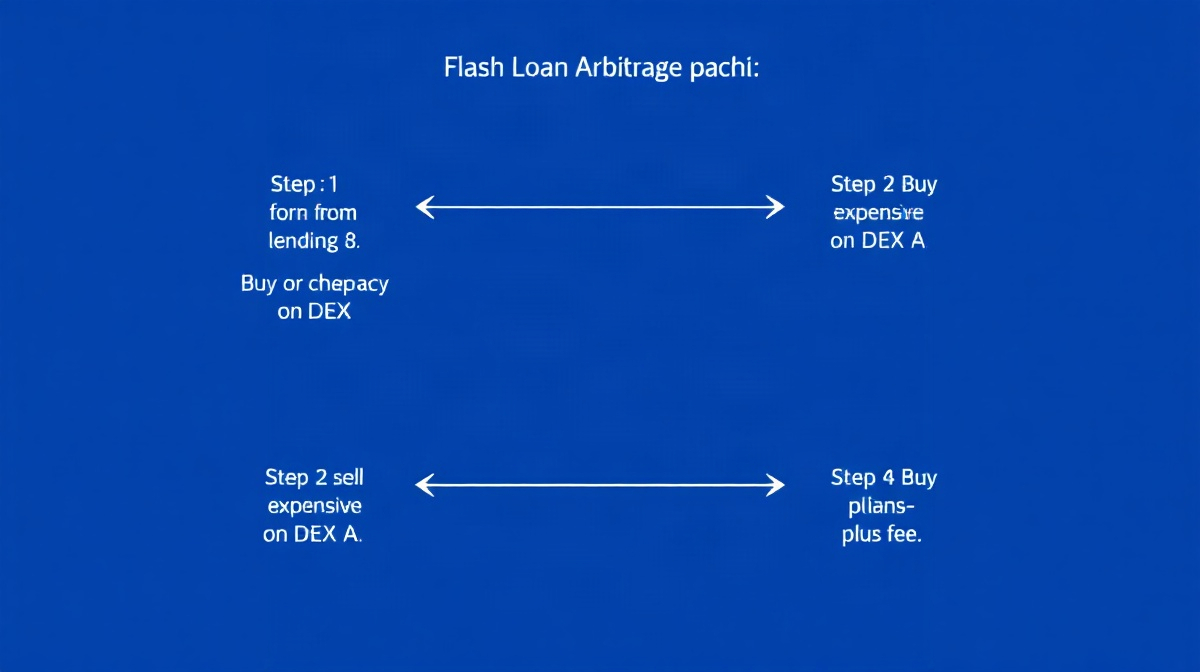
- Borrow: A smart contract calls the lending pool's flash loan function, requesting a specific amount of a token (e.g., 500 WETH).
- Callback execution: The lending pool sends the funds to the borrowing contract, then immediately calls back into that contract's
executeOperation() function (Aave's naming convention), where the actual logic runs. - Arbitrary logic: Inside the callback, the contract does whatever it was built to do — swap on one DEX, swap back on another, liquidate an undercollateralized position, or refinance debt.
- Repayment: Before the callback function finishes, the contract must transfer the borrowed amount plus the fee back to the lending pool.
- Validation and finality: The lending pool checks its balance increased by at least the loan plus fee. If so, the transaction completes. If not, the entire transaction — including the initial borrowing step — reverts.
This is the core mechanic behind every flash loan: borrowing and repayment are bound together by the atomicity guarantee of the underlying blockchain. There is no trust required between the borrower and the lending protocol because the code enforces repayment or nothing happens at all.
Why Flash Loans Work for Traders With No Capital
Traditional borrowing requires proving creditworthiness or posting collateral. Flash loans invert this: the "proof" is the transaction's own success. A trader doesn't need $500,000 to use flash loans to move $500,000 of liquidity — they only need the gas fee to submit the transaction and a smart contract that guarantees repayment. This is precisely why flash loan arbitrage is accessible to anyone who can write (or rent) a Solidity contract, not just well-capitalized market makers.
Flash Loan Arbitrage Explained
Flash loan arbitrage is the practice of using a flash loan to exploit price discrepancies for the same asset across different decentralized exchanges (DEXs), automated market makers (AMMs), or lending markets — without needing to own the capital being arbitraged.
Because DEXs price assets based on their own liquidity pool ratios (via constant-product or concentrated-liquidity formulas), the same token pair can trade at slightly different prices on Uniswap, SushiSwap, Curve, Balancer, and various Layer 2 DEXs at any given moment. These discrepancies are usually small — a few basis points — but on a $1 million position, even a 0.3% spread nets $3,000 before fees.
Normally, capturing that spread would require owning $1 million in capital. Flash loan arbitrage removes that requirement entirely: borrow the $1 million, execute both legs of the trade, repay the loan plus fee, and keep the spread. This is the defining use case that made flash loans famous in DeFi arbitrage circles. For a broader survey of how this fits into the wider toolkit, see our breakdown of DeFi arbitrage strategies.
Why Price Discrepancies Exist
- Fragmented liquidity: Hundreds of DEXs and liquidity pools exist across Ethereum, Arbitrum, Base, Optimism, and other chains, each pricing assets independently based on local supply and demand.
- Large trades skew AMM pricing: A big swap on one DEX moves that pool's price along its bonding curve, creating a temporary gap versus pools that weren't touched.
- Latency and block timing: Oracle updates, CEX-DEX price feeds, and cross-chain bridges introduce brief windows where on-chain prices lag real market prices.
- New listings and low-liquidity pairs: Thinly traded pools are more prone to price dislocations that larger, deep pools arbitrage away quickly — but not always instantly.
This overlaps meaningfully with MEV and arbitrage, since many flash loan arbitrage transactions are also MEV opportunities captured by searchers running private mempools and block-building relationships with validators.
Step-by-Step: Executing a Flash Loan Arbitrage
Let's walk through a realistic WBTC/WETH arbitrage scenario to show exactly how a flash loan arbitrage transaction is constructed.
Scenario: WBTC is trading at 15.42 WETH on Uniswap V3 and 15.48 WETH on Balancer — a 0.39% spread. A searcher spots this and decides to use flash loans to capture it.
| Step | Action | Amount |
|---|
| 1 | Flash loan 500 WETH from Aave V3 (0.05% fee) | 500 WETH borrowed, 0.25 WETH fee owed |
| 2 | Swap 500 WETH → WBTC on Uniswap V3 (cheaper WBTC) | Receive ~32.43 WBTC |
| 3 | Swap 32.43 WBTC → WETH on Balancer (higher WBTC price) | Receive ~501.95 WETH |
| 4 | Repay flash loan + fee to Aave | Repay 500.25 WETH |
| 5 | Net profit (before gas) | ~1.7 WETH |
| 6 | Subtract gas cost (~0.03-0.08 WETH depending on network congestion) | Net profit ~1.6-1.7 WETH |
At a WETH price of roughly $3,200, that's a profit of approximately $5,400-5,440 on a transaction that required zero personal capital beyond the gas fee — captured and settled in roughly 12-15 seconds (one Ethereum block).
The Smart Contract Logic Behind the Trade
The contract executing this needs to:
- Call
flashLoanSimple() on Aave's Pool contract, specifying the asset (WETH) and amount (500). - Inside the
executeOperation() callback, call the Uniswap V3 router to swap WETH for WBTC with a minimum output amount (slippage protection). - Call the Balancer Vault to swap the received WBTC back to WETH.
- Approve and transfer the repayment amount (loan + fee) back to the Aave Pool.
- Transfer any remaining profit to the contract owner's wallet.
If the spread closes before the transaction confirms — because someone else already arbitraged it, or because the trader's own swap moves the price unfavorably — step 3's output will be less than the repayment amount, the contract will fail to repay, and the whole transaction reverts. The borrower loses only the gas fee for the failed attempt, never the loan principal itself. You can model spreads like this yourself with an arbitrage calculator before committing a transaction.
Top Flash Loan Protocols Compared
Not all flash loan providers are equal. Fee structure, maximum loan size, and chain availability materially affect which protocol a searcher chooses for a given opportunity.
| Protocol | Flash Loan Fee | Max Loan Amount | Chains Supported | Notes |
|---|
| Aave V3 | 0.05% | Limited by pool liquidity (often $50M+ for major assets) | Ethereum, Arbitrum, Optimism, Polygon, Avalanche, Base | Most widely used; largest liquidity depth, mature flashLoanSimple() and multi-asset flashLoan() functions |
| dYdX | 0% (no fee, only requires 2 wei rounding repayment) | Limited by pool balance on Starkware/v4 chain | dYdX Chain (Cosmos-based) | Historically fee-free on v3; v4 migrated to its own appchain, changing flash loan access patterns |
| Uniswap V3 | 0% flash fee via "flash swaps," but pool swap fee (0.01%-1%) applies on the borrowed-and-returned leg | Limited by pool reserves | Ethereum, Arbitrum, Base, Optimism, Polygon | Not a dedicated lending pool — uses the flash() function on pair contracts directly |
| Balancer V2/V3 | 0% (protocol-level flash loans are fee-free; only swap fees apply elsewhere) | Limited by Vault liquidity per token | Ethereum, Arbitrum, Base, Polygon | Vault architecture pools all liquidity together, enabling very large flash loan amounts for major tokens |
| Morpho | Typically 0% on Morpho Blue flash loans | Limited by available market liquidity | Ethereum, Base | Newer modular lending protocol; flash loan access depends on individual isolated market liquidity |
A few things to note when comparing these for flash loan arbitrage:
- Fees matter at scale. On a $1M flash loan, Aave's 0.05% fee costs $500 — negligible against a profitable spread, but it compounds on repeated bot activity across thousands of transactions per month.
- Max amount is a liquidity function, not a hard cap. None of these protocols impose an arbitrary ceiling; the real constraint is how much of the target asset sits in the pool at execution time.
- Balancer and Uniswap's fee-free flash mechanisms make them attractive for high-frequency arbitrage bots that need to minimize fixed costs per transaction, especially when margins are thin.
- Chain choice affects gas economics. The same flash loan arbitrage on Ethereum mainnet might cost $40-150 in gas during congestion, versus a few cents on Arbitrum or Base — which matters enormously when net profit per transaction is already slim.
Flash Loan Arbitrage vs Traditional Arbitrage
| Factor | Flash Loan Arbitrage | Traditional Arbitrage |
|---|
| Capital required | None (beyond gas) | Full position size upfront |
| Execution speed | Single block (~12 seconds on Ethereum) | Minutes to days, depending on venue |
| Settlement risk | None — atomic, reverts if unprofitable | Price can move against you mid-execution |
| Collateral | Not required | Required for margin-based arbitrage |
| Access barrier | Solidity/smart contract development skill | Capital and exchange account access |
| Competition | High — bots compete in the same mempool | Lower frequency, often manual or semi-automated |
| Fee structure | Protocol fee + DEX swap fees + gas | Exchange trading fees + withdrawal fees |
| Scalability | Limited by pool liquidity, not personal wealth | Limited by personal/fund capital |
The core advantage of flash loan arbitrage is capital efficiency — a trader with $0 in crypto holdings can still compete for the same spread as a fund holding $10 million, because both are ultimately constrained by the same on-chain liquidity. The tradeoff is technical complexity and intense competition: because there's no capital barrier to entry, hundreds of bots monitor the same opportunities simultaneously, and most profitable spreads get captured within a block or two of forming.
Building a Flash Loan Bot
Building a functional flash loan arbitrage bot requires both on-chain (Solidity) and off-chain (monitoring/execution) components. Here are the core concepts — not a full implementation, but the architecture you'd need to understand.
On-Chain: The Arbitrage Contract
A flash loan arbitrage contract typically inherits from the lending protocol's flash loan receiver interface (e.g., Aave's IFlashLoanSimpleReceiver). The core logic lives in the callback function:
- Receive the loan: The protocol calls your contract with the borrowed asset and amount.
- Route the trade: Your contract calls DEX router contracts (Uniswap's
SwapRouter, Balancer's Vault, Curve's pool contracts) in sequence, passing output from one swap as input to the next. - Slippage protection: Every swap call should specify a
minAmountOut to prevent the transaction from completing at an unprofitable price due to front-running or pool movement. - Repay and settle: Approve the lending pool to pull the loan plus fee, then transfer remaining balance to an owner-controlled address.
- Access control: Restrict who can trigger the arbitrage function (typically
onlyOwner or a whitelisted executor) to prevent others from hijacking your contract's logic or griefing your gas.
Off-Chain: Monitoring and Triggering
The on-chain contract is useless without a system that detects opportunities and decides when to fire the transaction:
- Price monitoring: Continuously poll or subscribe to price feeds across target DEXs to detect spreads exceeding your minimum profitable threshold (accounting for fees and gas).
- Simulation before submission: Run the full transaction through a local fork or simulation RPC (e.g., Tenderly, Anvil) to confirm profitability before spending real gas.
- Gas price strategy: Decide whether to use a private relay (Flashbots Protect, MEV-Share) to avoid front-running, or compete openly in the public mempool with aggressive gas bidding.
- Nonce and timing management: Ensure your bot can submit transactions quickly enough to beat competing searchers to the same opportunity.
This is a nontrivial engineering project — most successful flash loan arbitrage bots are built and maintained by teams, not solo weekend projects, precisely because the competition is dominated by well-resourced MEV searchers.
Flash Loan Attacks vs Legitimate Arbitrage
Flash loans are a neutral tool — the same mechanism that powers legitimate arbitrage also powers some of DeFi's most damaging exploits. Understanding the difference matters both for builders and for anyone evaluating protocol risk.
Oracle Manipulation Attacks
The most common flash loan attack pattern exploits protocols that price assets using a single DEX's spot price instead of a time-weighted or decentralized oracle. An attacker:
- Borrows a large flash loan.
- Uses it to execute a massive swap on a thinly liquid pool, temporarily distorting that pool's spot price.
- Interacts with a victim protocol that reads the manipulated price (e.g., to borrow against inflated collateral or trigger a favorable liquidation).
- Reverses the initial swap and repays the flash loan, pocketing the difference extracted from the victim protocol.
This is fundamentally different from legitimate flash loan arbitrage: arbitrage exploits a natural price discrepancy between two honest markets, while an oracle manipulation attack artificially creates a price discrepancy and exploits a protocol's flawed trust in a single, manipulable price source. Protocols that rely on Chainlink oracles or time-weighted average prices (TWAPs) from deep liquidity pools are far more resistant to this class of attack.
Governance Attacks
A related exploit uses flash loans to temporarily acquire enough governance tokens to pass a malicious proposal within a single transaction or voting window, then returns the tokens immediately after. This attack vector led several DAOs to implement voting delays, snapshot-based voting (recording balances at a past block rather than real-time), or minimum holding periods specifically to neutralize flash-loan-based governance manipulation.
Key Distinction
| Legitimate Flash Loan Arbitrage | Flash Loan Attack |
|---|
| Price source exploited | Natural spread between independent markets | Artificially manipulated single price feed |
| Victim | None — captures value from inefficiency | A specific protocol or its users |
| Reversibility | N/A — both legs are genuine trades | Attack is possible only because of the manipulation itself |
| Protocol defense | N/A | TWAP oracles, Chainlink feeds, reentrancy guards, governance timelocks |
Risks and Challenges
Even purely legitimate flash loan arbitrage carries real risks and operational challenges:
- Gas wars. When a profitable spread appears, multiple bots race to capture it. This drives up gas prices for that block, and only the winning transaction gets included with the arbitrage intact — everyone else's transaction either reverts (losing gas) or never confirms.
- Failed transactions still cost gas. Even though the loan itself reverts safely if unprofitable, the gas spent attempting the transaction is non-refundable. A bot that misjudges slippage or gets front-run can bleed money on failed attempts even while never losing loan principal.
- Smart contract bugs. A flaw in your own arbitrage contract — an incorrect
minAmountOut, a missed approval, an integer rounding error — can cause unexpected reverts or, worse, loss of funds if the contract holds any balance between transactions. - MEV competition and sandwich risk. Public mempool transactions can be seen by searchers who front-run or sandwich your swap legs, eating into or eliminating your expected profit before your transaction confirms.
- Protocol risk. Lending pools themselves can be paused, have liquidity withdrawn, or suffer exploits that affect flash loan availability and terms with little warning.
- Diminishing returns. As more sophisticated bots compete for the same spreads, average profit per opportunity shrinks, and only the fastest, most efficient operations remain consistently profitable.
- Regulatory ambiguity. Flash loan arbitrage operates in a legally undefined space in most jurisdictions; while it's not theft or hacking, regulators have not issued clear guidance specific to this activity.
Managing these risks requires careful transaction simulation, conservative slippage settings, private relay usage where possible, and continuous monitoring of gas markets and liquidity conditions.
How ArbiScreen Helps
Spotting a profitable flash loan arbitrage opportunity before it disappears requires real-time visibility across dozens of DEXs and liquidity pools simultaneously — something no human can track manually. ArbiScreen monitors spreads across major DEXs and chains continuously, surfacing price discrepancies the moment they appear so you can evaluate whether a given opportunity clears your profitability threshold after accounting for flash loan fees, DEX swap fees, and estimated gas.
Rather than polling dozens of pools yourself, ArbiScreen's Spread Scanner aggregates live pricing data and flags spreads worth investigating, giving arbitrage searchers — whether running manual trades or automated flash loan bots — a faster path from opportunity detection to execution decision. Pairing real-time spread monitoring with your own simulation and execution pipeline is how most serious flash loan arbitrage operations stay competitive in a market where opportunities often close within seconds.
Is Flash Loan Arbitrage Still Profitable in 2026?
Flash loan arbitrage remains profitable in 2026, but the profile has shifted significantly since its early-2020s heyday. Average spreads on major pairs (ETH/USDC, WBTC/WETH) on Ethereum mainnet have compressed as competition intensified — most spreads above 0.2% get captured within a single block by established MEV searchers running optimized infrastructure.
However, profitability persists in several areas:
- Layer 2 and alt-L1 chains (Arbitrum, Base, Optimism) see less bot saturation than Ethereum mainnet, and lower gas costs mean smaller spreads remain profitable after fees.
- Long-tail token pairs and newer liquidity pools continue to generate larger, less-competed spreads due to thinner liquidity and fewer bots monitoring them.
- Cross-chain and cross-protocol opportunities (e.g., discrepancies between a DEX price and a lending protocol's liquidation threshold) remain less commoditized than simple two-DEX arbitrage.
- New protocol launches routinely create temporary liquidity imbalances before arbitrageurs and market makers fully normalize pricing across venues.
The bar for entry has risen: casual arbitrage with unsophisticated bots on Ethereum mainnet is largely unprofitable after gas and competition. But for builders willing to invest in proper infrastructure — private relays, simulation pipelines, multi-chain monitoring, and tight capital-efficient contracts — flash loan arbitrage continues to be a viable, collateral-free strategy for extracting value from DeFi's inherent market fragmentation.
FAQ
What is a flash loan in simple terms?
A flash loan is a loan you borrow and repay within the same blockchain transaction, with no collateral required. If you can't repay it instantly — including any fees — the entire transaction cancels automatically, so the lender never actually loses funds.
How do flash loans work without collateral?
Flash loans work without collateral because the blockchain's atomicity guarantees that either the entire transaction (borrow, use, repay) succeeds, or none of it happens. The lending protocol never faces default risk because an unrepaid loan simply reverts the transaction as if it never occurred.
What is flash loan arbitrage?
Flash loan arbitrage is using a flash loan to borrow capital, buy an asset cheaply on one DEX, sell it for more on another DEX, repay the loan plus fees, and keep the remaining profit — all within a single transaction, without needing to own the capital upfront.
Do I need coding skills to use flash loans?
Yes, realistically. Executing a flash loan requires deploying and calling a smart contract, typically written in Solidity, that handles the borrow-swap-repay logic. There's no simple UI for flash loan arbitrage the way there is for regular token swaps.
What are typical flash loan fees?
Fees vary by protocol: Aave charges roughly 0.05% of the borrowed amount, while Balancer and Uniswap's native flash mechanisms are often fee-free at the protocol level (though standard swap fees still apply on any trades executed). Always factor fees into your profitability calculation before submitting a transaction.
Can a flash loan arbitrage transaction fail?
Yes. If the price spread closes or moves unfavorably before your transaction confirms — often because a competing bot captured it first — your repayment leg won't generate enough funds, and the entire transaction reverts. You lose the gas fee spent attempting it, but never the loan principal, since the loan itself was never truly disbursed outside the failed transaction.
Is flash loan arbitrage considered a hack or exploit?
No. Legitimate flash loan arbitrage captures natural price discrepancies between independent, honestly-functioning markets. It becomes an attack only when flash loans are used to manipulate a price oracle or temporarily acquire governance power to exploit a specific protocol's flawed logic.
Which protocol offers the biggest flash loans?
Aave V3 generally offers the deepest flash loan liquidity for major assets like WETH and USDC due to its large total value locked, though Balancer's Vault architecture can also support very large flash loans for specific tokens depending on pool composition.
How much capital do I need to start with flash loans?
Technically none for the loan itself — only enough to cover gas fees for deploying your contract and submitting transactions. This is the core appeal: flash loan arbitrage doesn't require pre-funded trading capital, unlike traditional arbitrage.
What chains support flash loan arbitrage?
Ethereum mainnet, Arbitrum, Optimism, Base, and Polygon all support flash loans through Aave, Balancer, and native DEX flash-swap mechanisms. Layer 2 chains often see less competition and lower gas costs, which can make smaller spreads worthwhile.
How fast does a flash loan arbitrage transaction execute?
The entire borrow-swap-repay sequence executes within a single block, which takes roughly 12 seconds on Ethereum mainnet and often less on Layer 2 networks. There's no multi-step waiting period like traditional lending or arbitrage.
What's the biggest risk in flash loan arbitrage?
Beyond smart contract bugs, the biggest practical risk is competition: gas wars and MEV bots racing for the same spread can cause your transaction to fail (costing gas) or get front-run, eroding or eliminating expected profit even when your strategy is sound.
Related Articles